
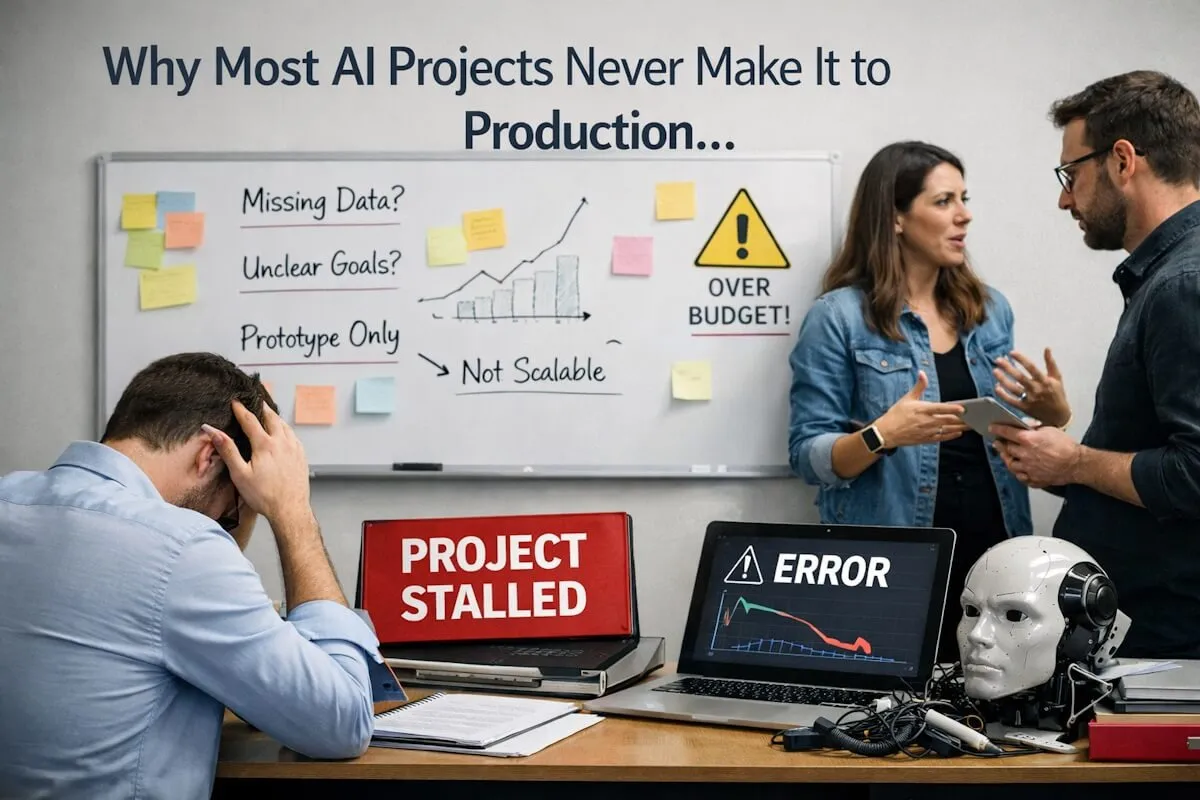

You’ve probably seen it happen. A company gets excited about AI. A few meetings later, there’s a prototype. It looks promising. People nod in approval. Then… nothing. The project stalls. Weeks turn into months. Eventually, it quietly fades away.
So what’s going wrong?
If you’re planning to invest in AI or already started, this question matters. A lot. Because building a demo is easy. Getting it into production, where it actually drives value, is a whole different story.
Let’s break this down in a real, no-nonsense way.
The Gap Between Idea and Execution
Most teams jump into AI with big expectations. They want quick results. Faster decisions. Better customer experience.
Sounds good, right?
But here’s the catch. AI projects are not like typical software builds. You don’t just write code and ship it. There’s data involved. There’s constant tuning. There’s uncertainty.
That’s where many teams struggle.
They treat AI like a plug-and-play feature. It’s not.
You need planning, iteration, and patience. Without that, things fall apart early.
Poor Problem Definition
This is one of the biggest reasons projects fail.
A team decides, “We need AI.” But for what exactly?
If the problem isn’t clear, the solution won’t be either.
Let’s say you want to “improve customer experience.” That’s vague. What does it mean in practice?
- Faster support replies?
- Personalized recommendations?
- Predicting churn?
Each of these needs a completely different approach.
When goals are fuzzy, teams end up building something that doesn’t really solve anything. And when stakeholders don’t see value, the project gets dropped.
Simple rule. If you can’t explain the use case in one clear sentence, you’re not ready yet.
Data Issues No One Talks About Enough
AI depends heavily on data. But most companies underestimate how messy their data actually is.
You might have:
- Missing records
- Inconsistent formats
- Outdated information
- Data spread across multiple systems
Now imagine trying to build something reliable on top of that.
It’s tough.
Even worse, teams often realize these issues too late. By then, timelines are already slipping.
Before writing a single line of code, your data needs a reality check.
Ask yourself:
- Is it clean?
- Is it enough?
- Is it relevant?
If not, fix that first.
Lack of Skilled Talent
This one is obvious but still worth talking about.
AI projects need people who understand both data and real-world applications. Not just theory.
Many companies either:
- Hire too late
- Hire the wrong people
- Or rely on general developers to figure it out
That rarely works.
You need specialists who know how to build, test, and refine models in practical settings.
This is where working with teams offering AI Development Services can make a difference. Instead of guessing your way through, you get people who’ve already dealt with similar challenges.
And that can save months of trial and error.
Prototypes That Never Scale
Building a prototype is exciting. You see results quickly. Everyone feels like progress is being made.
But production is a different beast.
What works on a small dataset may fail when exposed to real-world traffic.
Some common issues:
- Slow response times
- High infrastructure costs
- Inconsistent results
Scaling requires careful engineering. It’s not just about the model. It’s about the entire system around it.
Teams often ignore this until it’s too late.
No Clear Ownership
Here’s something that doesn’t get discussed enough.
Who owns the AI project?
Is it the data team? Engineering? Product? Leadership?
When ownership is unclear, progress slows down.
Decisions get delayed. Priorities shift. Accountability disappears.
Every successful project has a clear owner. Someone responsible for pushing things forward and making calls when needed.
Without that, things drift.
Unrealistic Expectations
AI is powerful, but it’s not magic.
Some teams expect perfect results from day one. When that doesn’t happen, they lose confidence.
But here’s the truth. AI systems improve over time. They need testing, feedback, and refinement.
If you expect instant perfection, you’ll always be disappointed.
Set realistic goals:
- Start small
- Measure progress
- Improve gradually
That mindset makes a huge difference.
Integration Challenges
Let’s say your model works great.
Now what?
It needs to connect with your existing systems. APIs, databases, user interfaces. Everything.
This step is often underestimated.
Integration can get messy:
- Legacy systems don’t play well
- Data pipelines break
- Performance issues show up
If integration fails, the project fails. No matter how good the model is.
Lack of Continuous Monitoring
Even after deployment, the work isn’t done.
Data changes over time. User behavior shifts. External factors come into play.
If you don’t monitor your system, performance will drop.
And slowly, the results become unreliable.
You need ongoing tracking, updates, and adjustments. This is not a one-time effort.
Budget and Timeline Pressure
AI projects often take longer than expected.
When budgets are tight, teams cut corners. They skip important steps. They rush decisions.
That leads to poor outcomes.
It’s better to start with a smaller, focused project and expand later.
Trying to do everything at once usually backfires.
Communication Gaps Between Teams
AI projects sit at the intersection of multiple teams.
Data experts. Developers. Business stakeholders.
If these groups don’t communicate well, problems start showing up quickly.
For example:
- Business expects one thing
- Technical team builds something else
Now you have misalignment.
Regular check-ins and clear communication can prevent this.
The Role of the Right Hiring Approach
Let’s talk about something practical.
A lot of companies struggle because they don’t have the right people in place from the start.
Instead of building everything in-house, many teams now choose to hire AI Developers who already have hands-on experience.
Why?
Because it speeds things up. You avoid beginner mistakes. You get better results faster.
It’s not about outsourcing blindly. It’s about making smart decisions based on your team’s strengths and gaps.
So, What Should You Do Differently?
If you want your AI project to actually reach production, focus on these:
- Define a clear, specific problem
- Audit your data early
- Start small and scale gradually
- Bring in the right expertise
- Plan for integration from day one
- Monitor performance continuously
No shortcuts here.
The Real Takeaway
AI projects don’t fail because the idea is bad.
They fail because execution is messy.
It’s easy to get excited about possibilities. Harder to deal with the details.
But if you pay attention to those details, your chances of success go up significantly.
So before you jump into your next AI project, ask yourself one thing.
Are you building something that looks good in a demo, or something that will actually work in the real world?
That answer changes everything.