
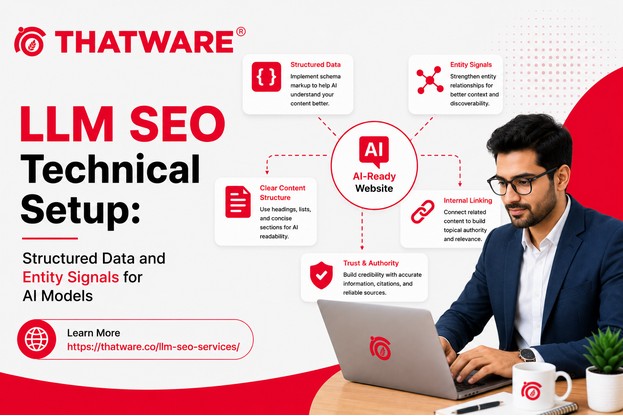

There’s a content side to LLM SEO — the articles, the thought leadership, the press coverage — and then there’s the technical side. The structured data, the entity signals, the machine-readable layer of your digital presence that helps AI systems understand who you are, what you do, and where you fit. Both matter. But the technical side tends to get underestimated, mostly because it’s less visible and harder to talk about in marketing terms.
If your content is what an AI model reads about you, the technical infrastructure is what tells it how to categorize you. Get the latter wrong, and all your content investments are working against a headwind.
What “Entity” Means in This Context
LLMs don’t just process text — they build internal representations of things. Your company is an entity. Your products are entities. The people who lead your organization are entities. The category you operate in is an entity.
Entities have properties: what they are, what they do, who they’re associated with, what other entities they’re connected to. When an AI model receives a query about your space, it draws on its representations of relevant entities to construct an answer. The richer and more accurate those entity representations, the more likely your brand gets cited correctly.
Entity signals are the information sources that shape those representations: your website’s structured data, your knowledge graph presence, Wikipedia and Wikidata entries if they exist, business directory listings, schema markup on your pages, and the way other websites describe and link to you.
Building strong entity signals is a technical discipline. Let’s get specific about what that involves.
Schema Markup: Still Foundational, Just Different
Schema.org markup has been a traditional SEO best practice for years, but its role in LLM SEO is somewhat different. Rather than primarily serving Google’s rich snippets, schema now helps AI systems categorize and understand entities at a machine-readable level.
For most companies, the priority schemas are: Organization (establishing your brand as a recognized entity with consistent attributes), Product or Service (describing your offerings with specific, accurate attributes), Person (for founders, executives, or thought leaders you want to have recognized), and FAQ or HowTo schemas on content pages where those formats are genuinely appropriate.
What’s important is accuracy over cleverness. Schema markup that misrepresents what you do in an attempt to appear in more answer categories actually creates conflicting signals. If your Organization schema says you’re a “marketing technology company” but your content presents you as a “data analytics firm,” that inconsistency is a problem. Clean, specific, accurate schema data is worth far more than aspirationally broad categorization.
Knowledge Graph Presence and Wikidata
AI models draw heavily from structured knowledge sources — and Wikidata in particular is an important one. Wikidata is a collaborative, machine-readable knowledge base that feeds into both Wikipedia and various AI systems. If your company is large enough or significant enough in your category to have a Wikidata entry, ensuring that entry is accurate and complete is worth the effort.
For companies that don’t yet qualify for Wikidata or Wikipedia coverage, the goal is to build toward it — primarily by generating the kind of third-party coverage that makes a Wikipedia entry appropriate. A company with substantial documented impact, credible coverage in reliable sources, and a clear place in its industry’s history is a Wikidata-eligible entity. Getting there is a medium-term goal worth working toward.
In the meantime, structured listings on business databases that major AI systems reference — Crunchbase for startups, industry-specific databases relevant to your category, government business registries — contribute to entity verification signals.
Site Architecture and Information Hierarchy
How your website is organized sends entity signals that AI systems pick up on. A well-structured website where the relationship between pages is logical — company overview leads naturally to products, products link to use cases, use cases connect to customer evidence — creates a navigable information graph that models can traverse coherently.
The practical implications: your most important entity information (what you are, what you do, who you serve) should be clearly accessible from your homepage and well-interlinked across your site. Product pages should not be orphaned. Your “About” information should be consistent with how you’re described elsewhere. The website should read, to a system parsing it, as a coherent description of a well-defined entity — not a collection of disconnected content pieces.
LLM optimization services that include technical audits will often identify site architecture problems that are invisible in traditional SEO audits but significant for AI visibility. A common finding: large sites where product and service pages have inconsistent or vague descriptions, making it difficult for models to build accurate category associations.
NAP Consistency and Distributed Entity Signals
Name, Address, Phone — the classic local SEO consistency principle — has an analog in LLM entity signals. Your company name, product names, category descriptions, and core value propositions should be consistent across your own site, your social profiles, your business directory listings, your press mentions (where you can influence them), and your partner and affiliate sites.
Inconsistency here is more damaging than most brands realize. If your company is called “Acme” on your website, “Acme Inc.” on LinkedIn, “Acme Technologies” in press releases, and “AcmeTech” in partner profiles, that’s four different entity strings for a model to reconcile. It might get it right, or it might treat them as different entities, diluting your consolidated representation.
Conducting a brand consistency audit — systematically checking how your brand is named and described across every place it appears online — is unglamorous but essential groundwork. Clean it up before investing heavily in content or coverage.
Internal Linking as a Semantic Signal
Internal linking in LLM SEO isn’t primarily about PageRank flow — it’s about semantic relationships. When a page about your enterprise product links to your case studies, your technical documentation, and your integration partners, you’re creating a machine-readable map of how those things relate.
AI systems that parse your site understand: “this company has an enterprise product that large companies use, that integrates with these other tools, that has produced these documented outcomes for customers.” That’s a richer entity representation than any individual page provides alone.
Think about your internal linking strategy as a way of helping AI systems understand the connections between your entities — products, customers, use cases, outcomes, team members — rather than just as a navigation or authority distribution tool.
LLM SEO optimization at the technical level is ultimately about clarity: helping AI models understand your brand accurately, consistently, and completely. The technical work creates the foundation. The content and distribution strategy builds on top of it. Skip the foundation and your content investments underperform. Get it right and everything else works better.